SeqMSE, Sequential MSE, 是一种后训练量化中的 encoding 搜索方法。
它不是简单按 min/max 直接定量化范围,而是为每一层准备多组候选 encoding,用 calibration 数据实际跑该层,然后选择让层输出重构误差最小的那组 encoding。
以 AIMET 的实现为例,SeqMSE 主要用于优化 weight / parameter encoding。它用层输出 activation tensor 的 reconstruction error 作为评价指标,但被搜索和冻结的是 Linear/Conv 的 weight quantizer encoding。这里的 activation 指中间张量,不是 activation quantizer。
核心问题
普通 PTQ 常见做法是:
统计 tensor min/max -> 计算 scale/zero -> quant/dequant这种方法的问题是容易受 outlier 影响。如果少数极端值把 min/max 拉得很宽,大多数数值会落在很少的量化等级里,导致量化误差变大。
SeqMSE 换了一个目标:不再只问“这个 tensor 的范围是多少”,而是问:
哪一个量化范围能让这一层的输出最接近浮点输出?总体流程
以 AIMET 的 weight SeqMSE 为例,流程是:
- 准备 FP32 model、QuantSim model 和 calibration data。
- 临时关闭 activation quantizers,避免 activation QDQ 干扰当前层 weight encoding 的选择。
- 只保留受支持模块的 weight quantizer,例如 Linear/Conv。
- 按模型拓扑顺序遍历每个支持的模块。
- 对当前模块的 weight encoding min/max 生成一组候选 encoding。
- 对每个候选 encoding 做 weight quant/dequant。
- 用 calibration activation tensor 跑当前模块。
- 计算量化输出和浮点输出之间的 reconstruction loss。
- 选择 loss 最小的 encoding,并 freeze 当前模块的 weight quantizer。
- 继续处理下一层。
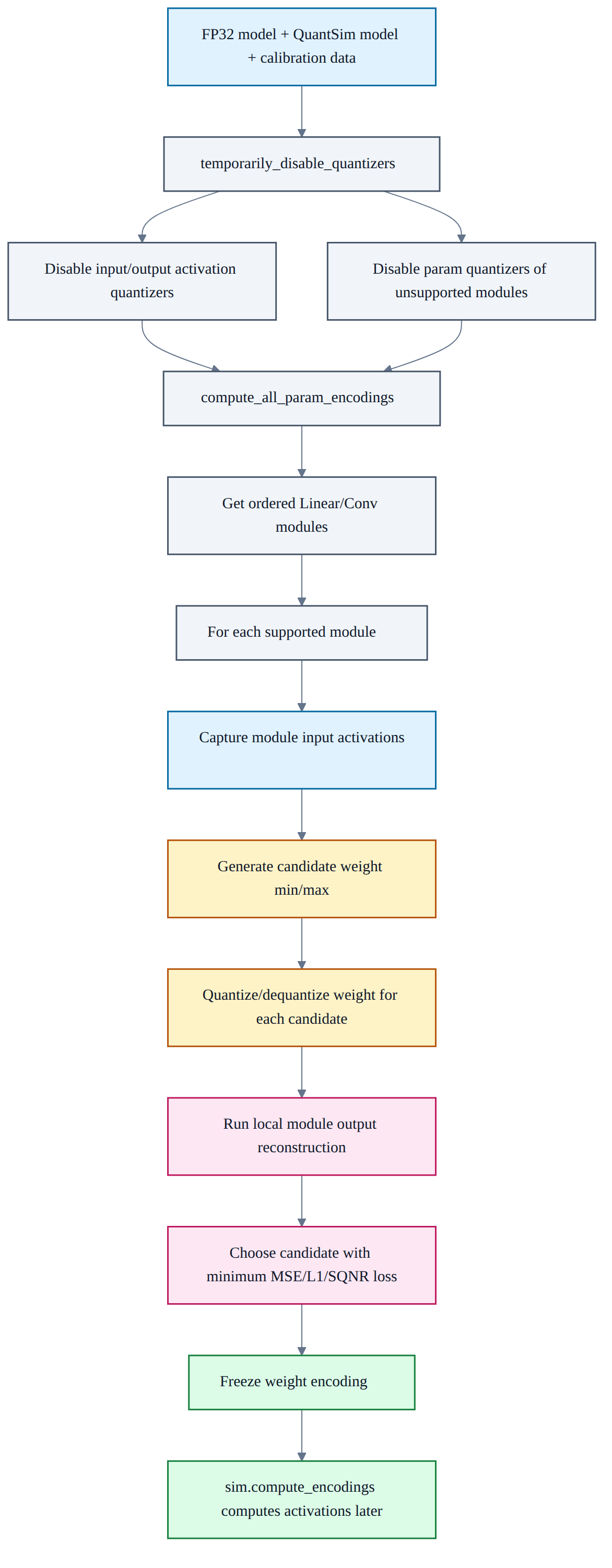
这个过程叫 sequential,是因为它按网络拓扑顺序逐层处理。前面层的 weight encoding 确定后,会影响后续层在 QuantSim 路径中看到的输入分布。注意,这里的影响主要来自前序层 weight quantization;SeqMSE 阶段 activation quantizers 通常是关闭的。
Encoding 是什么
Encoding 指量化参数,通常包括:
min/max: 浮点裁剪范围。scale: 每个整数刻度对应的浮点步长。zero: 零点。bitwidth: 量化位宽。sym/asym: 对称或非对称量化。
常见 affine quantization 可以写成:
q = clamp(round(x / scale) + zero, qmin, qmax)
x_hat = (q - zero) * scale
SeqMSE 搜索的本质就是:尝试多组 min/max,由它们导出不同的 scale/zero,然后看哪组让输出误差最小。
Activation tensor 和 activation quantizer
这两个词要分开:
- activation tensor:网络中间的浮点张量,例如某层输入
x、某层输出y。 - activation quantizer:负责给 activation tensor 计算 scale/zero,并对 activation 做 QDQ 的量化器。
SeqMSE 里参与的是 activation tensor,不参与的是 activation quantizer。
对一层 Linear:
y = x @ wSeqMSE 会用 calibration 里采到的 x 去测试不同 weight encoding 的好坏:
y_ref = x @ w
y_q   = x @ wq
loss  = MSE(y_q, y_ref)
这里 x 和 y 都是 activation tensor,它们参与前向和 loss;但 x 和 y 不会在 SeqMSE 阶段再经过 activation quantizer。
候选范围怎么生成
AIMET 的典型候选生成方式是从当前 weight quantizer 里取初始范围。这里的 min/max 是 weight encoding 的 min/max,不是输入 activation 的 min/max:
max_tensor = quant_module.param_quantizers["weight"].get_max()
min_tensor = quant_module.param_quantizers["weight"].get_min()
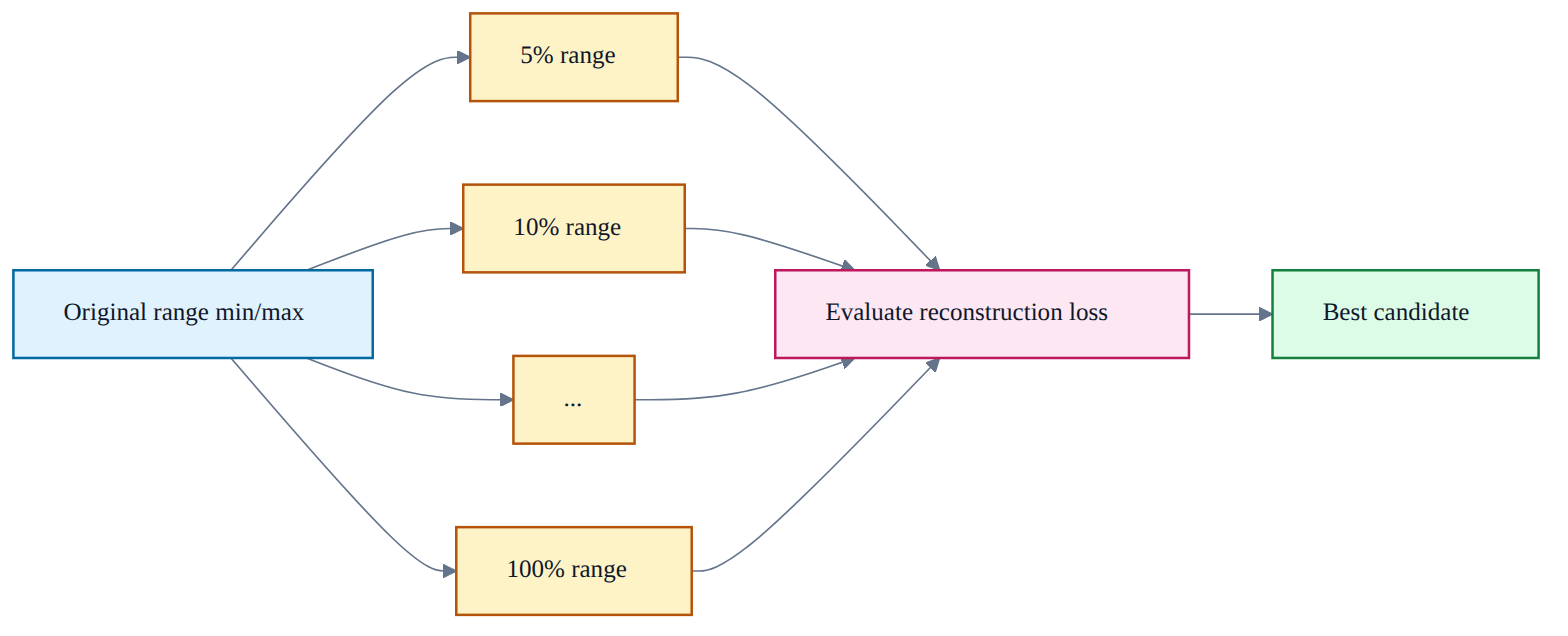
然后按 num_candidates 做线性缩放:
cand_max = max_tensor / num_candidates * (candidate_idx + 1)
cand_min = min_tensor / num_candidates * (candidate_idx + 1)
如果 num_candidates = 20,候选就是:
5%, 10%, 15%, ..., 100% of original range也就是说,SeqMSE 会尝试不同程度地裁剪 weight 的原始 encoding 范围。较小范围会牺牲 weight outlier,换取主体分布更细的量化刻度;较大范围保留 outlier,但主体分布的量化分辨率会下降。
Loss 怎么算
对 Linear 层,核心比较是:
float output:      y_ref = x_ref        @ w
quantized output:  y_q   = x_quant_path @ wq
loss:              L(y_q, y)
其中:
x_ref: reference 分支使用的输入 activation tensor。x_quant_path: QuantSim 路径中采到的输入 activation tensor,具体取法由策略决定。w: 浮点 weight。wq: 当前候选 encoding 下 quant/dequant 后的 weight。L: reconstruction loss,常见是 MSE。
SeqMSE 阶段通常不会再把当前层输出 y_q 送进 activation quantizer。也就是说,它比较的是当前层 float output tensor 和 weight-QDQ 后的 output tensor,而不是“output activation 再量化后”的结果。
AIMET 默认支持的 loss 包括:
mse: mean squared error。l1: absolute error。sqnr: signal-to-quantization-noise ratio 的负值,优化时等价于最大化 SQNR。
默认 MSE 可以理解为:
loss = sum((y_q - y)^2)在代码里,它会保留 channel 维度上的 loss,以支持 per-channel 或 block-wise 选择:
loss = loss_fn(xw, xqwq, reduction="none").sum(0)Block-wise SeqMSE
对 Linear,AIMET 会按 input channel 方向切 block。每个 block 可以独立计算 reconstruction loss,因此可以为不同 block/channel 选择不同候选。
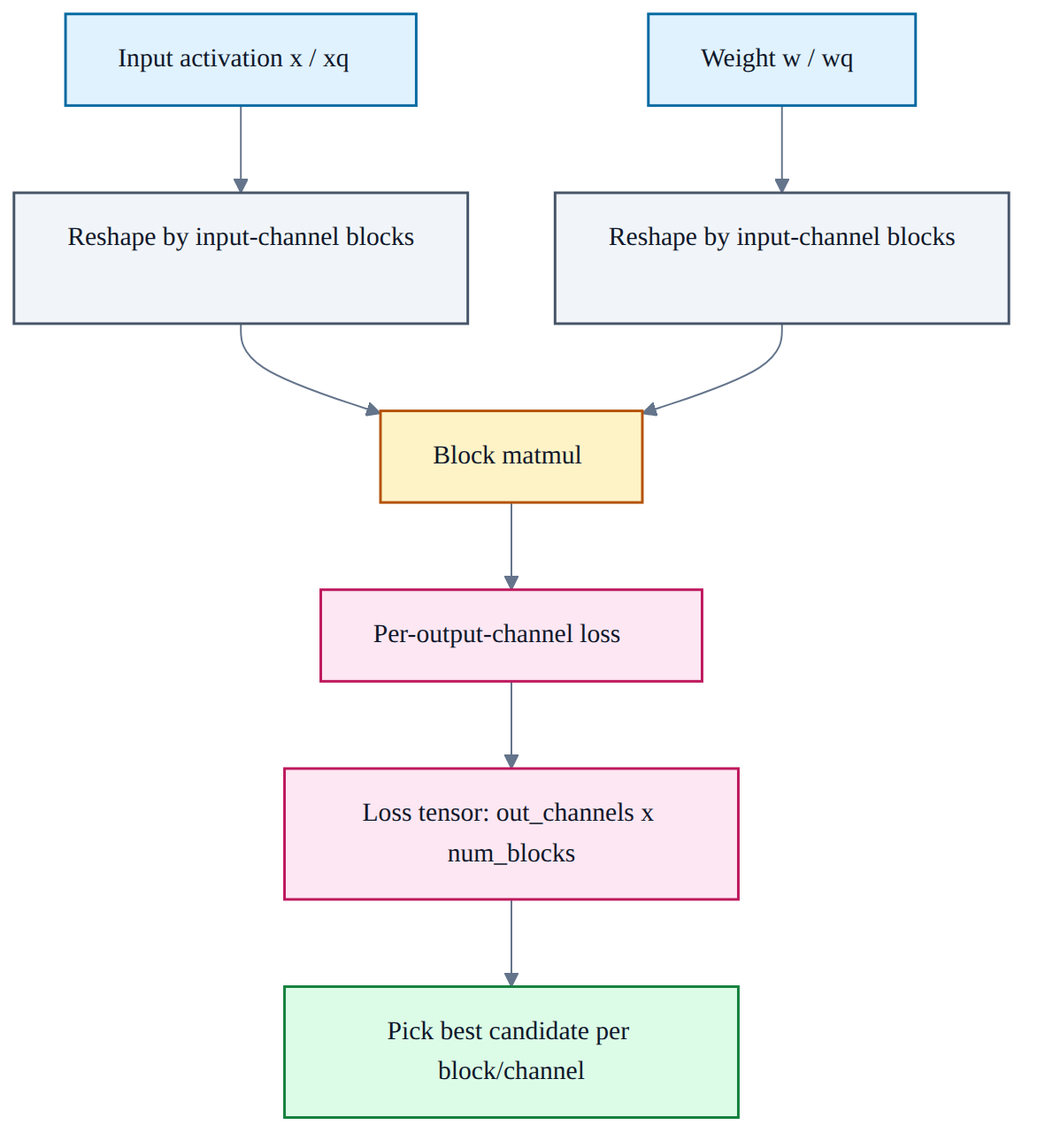
直观上:
- 把输入
xreshape 成多个 input-channel block。 - 把 weight
w也按 input-channel block 切开。 - 对每个候选 weight encoding 计算
x_quant_path @ wq。 - 与
x @ w对比。 - 得到每个 block 的 loss。
- 为每个 block 选择 loss 最小的候选。
这比 per-tensor 搜索更细,但也更依赖 backend 是否支持对应粒度的 weight quantization。AIMET 的 Linear block-wise 逻辑通常沿 in_channels 方向分块,隐含要求 block size 能整除该维度;如果不能整除,通常需要换 block size、fallback 到 per-tensor/per-channel,或者在量化配置阶段拒绝。
输入 activation 的三种取法
AIMET 的 SeqMSE 有一个 inp_symmetry 参数,它不是量化 symmetric/asymmetric 的意思,而是决定重构时 x_ref 和 x_quant_path 怎么取。这里的 x_quant_path 不是 activation quantizer 量化后的 x,而是从 QuantSim model 路径采到的当前层输入;由于前序层 weight quantizer 可能已经开启并冻结,它会包含前序 weight quantization 造成的误差。
asym
x_ref        = FP32 model input activation tensor
x_quant_path = QuantSim model input activation tensor
这种方式更接近完整量化路径对比,因为当前层的 quant 分支输入已经包含前面层 weight quantization 造成的误差。但它也把前序层误差和当前层 weight encoding 误差混在了同一个 loss 里。
symfp
x_ref        = FP32 model input activation tensor
x_quant_path = FP32 model input activation tensor
这种方式只看当前层 weight quantization 本身造成的误差,不把前序层的量化误差引入当前层。
symqt
x_ref        = QuantSim model input activation tensor
x_quant_path = QuantSim model input activation tensor
这是 AIMET 默认值。它用 QuantSim 路径中当前层实际会看到的输入分布做优化,但 float reference 和 quantized output 使用同一份输入,从而把优化重点放在当前层 w -> wq 的误差上。
为什么要按顺序做
SeqMSE 是 sequential 的原因是:量化误差会沿网络传播。
如果一次性独立优化所有层,每层看到的输入可能都还是理想 FP32 activation。但 SeqMSE 逐层冻结前序层 weight encoding 后,第 N 层在 QuantSim 路径中采到的输入会带有前 N-1 层 weight quantization 的影响。前面层一旦 freeze encoding,后面层的输入分布就随之确定。
因此逐层做有两个好处:
- 后面的层能看到更接近真实量化推理的输入分布。
- 每一层的局部优化目标更稳定。
它不是全局最优算法,但在 PTQ 场景下成本低、实现清晰,通常比纯 min/max 或简单 clipping 更稳。
SeqMSE 与普通 min/max 的区别
普通 min/max:
只看 tensor 自身分布。SeqMSE:
看这个 tensor 被量化后,对当前层输出造成多大影响。普通 min/max 的目标是覆盖范围;SeqMSE 的目标是输出重构质量。
这也是为什么它能主动裁掉 outlier:如果裁掉少量 outlier 能显著降低主体数据的量化误差,并让层输出更接近 FP32,那么 SeqMSE 会选择更窄的范围。
它优化的是什么,不优化什么
以 AIMET Torch 实现为准:
优化:
- Linear weight encoding。
- Conv2d weight encoding。
- 低 bit weight quantization,尤其是 4bit。
- 可支持 per-channel/block-wise weight encoding。
不直接优化:
- activation encoding 或 activation scale/offset。
- attention 内部 softmax/rotary/cache 等非 Linear 权重量化。
- 任意算子的全局误差。
- 端到端 PPL 或 accuracy 本身。
它使用 output activation tensor 的 MSE 做评价,但搜索对象仍然是 weight/parameter encoding。
简化伪代码
def seq_mse(model_fp, model_q, calib_data, num_candidates=20):
    disable_activation_quantizers(model_q)
    disable_unsupported_param_quantizers(model_q)

    for name, module_fp in ordered_supported_modules(model_fp):
        module_q = get_quant_module(model_q, name)

        x_ref, x_quant_path = collect_inputs(module_fp, module_q, calib_data)
        min0, max0 = module_q.weight_quantizer.get_min_max()

        losses = []
        candidates = []

        for i in range(num_candidates):
            ratio = (i + 1) / num_candidates
            cand_min = min0 * ratio
            cand_max = max0 * ratio

            module_q.weight_quantizer.set_encoding(cand_min, cand_max)
            wq = quant_dequant(module_q.weight, module_q.weight_quantizer)

            y_ref = linear_or_conv(x_ref, module_fp.weight)
            y_q = linear_or_conv(x_quant_path, wq)

            loss = reconstruction_loss(y_q, y_ref)
            losses.append(loss)
            candidates.append((cand_min, cand_max))

        best = argmin(losses)
        module_q.weight_quantizer.set_encoding(*candidates[best])
        module_q.weight_quantizer.freeze()

    restore_quantizers(model_q)
优点
- 比纯 min/max 更关注实际输出误差。
- 对 weight-only 或低 bit weight quantization 很有效。
- 不需要反向传播,不需要训练标签。
- 可以逐层执行,计算量可控。
- 可以扩展到 per-channel/block-wise encoding。
局限
- 它是局部优化,不保证端到端全局最优。
- calibration 数据质量会明显影响结果。
- 候选集合太窄可能找不到好 encoding,太宽则成本上升。
- 默认 AIMET 实现主要优化 weight encoding,不是 activation encoding。
- 如果 backend 不支持对应粒度的 encoding,算法选出来也无法落地。
和 AdaRound / GPTQ 的区别
SeqMSE:
- 搜索 min/max encoding。
- 通常不改 weight 数值本身,只改量化范围。
- 目标是层输出重构误差。
AdaRound:
- 优化 rounding decision。
- 重点是决定每个 weight 往上还是往下取整。
- 通常需要一个小的优化过程。
GPTQ:
- 利用 Hessian 近似做逐列/逐块 weight quantization。
- 更偏 LLM weight-only quantization。
- 会补偿量化误差。
可以粗略理解为:
SeqMSE: 选更好的尺子范围。
AdaRound: 选更好的取整方向。
GPTQ: 量化时顺手补偿误差。